Educators have known for years the power that teaching has on one's own understanding of specific content. Cooperative learning is one manner in which we attempt to capitalize on this process. Another way to achieve the same results is through tutoring programs. Virtually any subject taught at the college level can be conected to a tutoring program. In some instnaces, studens may provide tutoring to those at a much younger age. For instance, college students may be forced to reconsider there own understanding of algebra if they were to tutor pre-algebra middle schoolers. On the other hand, advanced collge biology students may gain more from tutoring intorductory college biology, or advanced high school students. Setting up tutoring programs can be time consuming, and when students don't show up, frustrating. For non-traditional or part-time students these arrangements may also be unrealistic. Cyber-tutoring may provide the answer.
Increasingly, students use the Internet to look for support and assistance. A well-designed web site catering to a specific group of students will attract a lot of attention, and may provide your students with more questions than they can find time to answer! A quick way to set up a site is through a software package such as O'Reilly WebBoard.
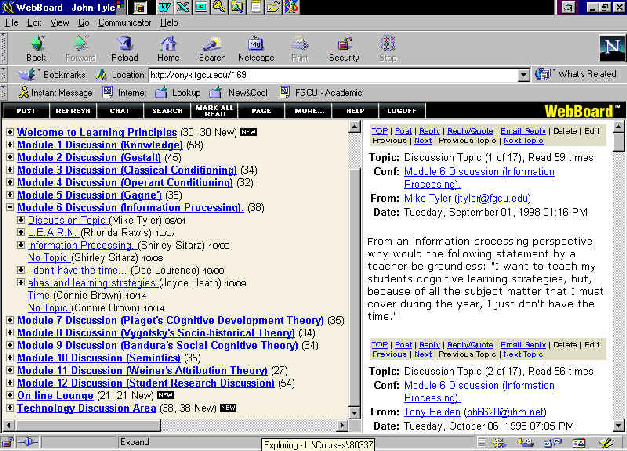
Below is a picture of a WebBoard in action. While the picture is bad, it conveys a general sense of the software. In the left hand column are "conferences." If you were teaching human biology, you might set up various conferences around major topics such as chromosomes and traits, genes and the human population, cells and tissues, and human behavior. Then, a small group of students might be assigned to each conference. Posted on the Internet with appropriate introductions, students in other settings who have questions about specific topics would be able to sign on to a conference and post their question. Then the student tutors would be responsible for responding. Experience across time would help the instructor determine how to advertise, how many students to assign to a conference, etc.
Another approach is to work with a group of students to create a complete homework helper site. Such a site might include additional resource information, supporting pictures, data, links, etc. Examples of such sites about and a quick search using any search engine for "homework help" will yield a number of examples. While creating a complete site requires some abiity to create web-based material, these sills are increasingly common among our students. As a cooperative learning project, a small group of students can each be assigned specific tasks that truly build on individual stregnths and results in not only a useful site, but positive learning as well!