Of
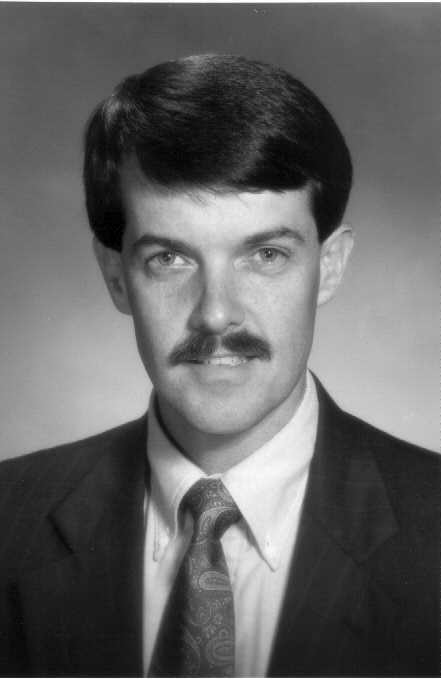
Commissioner Ray Judah
And The Estero Bay Case
Interviewed by: Pamela J. Borrego
This is about the historical perspective of Estero Bay and the surrounding water shed.
Commissioner Judah states that he was not living in or working in Lee County during the time when the Estuaries property was under the threat of development. The particular significance of Estero Bay at that time traveled beyond the state of Florida. Government, state, and private individuals paid great attention to the pioneering efforts that led to the protection of environmentally sensitive areas such as Estero Bay and the surrounding lands buffering Estero Bay.
The Commissioner felt that it was important for him to completely understand the goings on prior to and after, as well as what was presently going on at the time with this situation. The main point was that Robert Troutman, an attorney out of Atlanta, envisioned developing a thirty thousand housing unit community on the northern rim of Estero Bay. The people of Lee County are the ones who said No!, that the Mangrove, Wetlands and the major land cover surrounding the area that Robert Troutman wanted to develop was too important a natural resource to the marine fisheries, and to maintain the integrity of Estero Bay to let specific areas to be developed.
So, Lee County fought Robert Troutman taking it to the state level, which ultimately became the bases for state and local laws. These laws enabled local officials the ability to protect environmentally sensitive areas such as Mangrove forest and Wetland systems. The ability to provide protection to receiving water bodies such as Estero Bay would benefit Florida. Since that time, there have been a number of laws, acts, and regulations for protecting land, such as the Henderson Wetland Act approved by the State Legislatures during the 1980s.
In addition, Lee County implemented its own Mangrove Protection Ordinance and Wetlands Ordinance, each designed for the expressed purpose of protecting wetlands. The important reason is that Mangroves produce the vital stable within the marine food chain known as triode. The triode material comes from the leaves of the mangrove trees. The leaves fall into the water where microorganisms feed upon them and the whole food chain takes place. Small animals eat the microorganisms, larger animals eat the smaller animals and fish, and even larger animals feed upon the large animals and fish. Larger sport and commercial fish then eats those animals. A mangrove that produces the triodes, which supports the marine food chain, is the basic building block that supports a multimillion-dollar sport and commercial fishery industry. Mangroves also provide clarification as well as the cleaning of surface water runoffs into Estero Bay. So there is good science as to the importance of protecting the Mangrove and Wetlands in general and especially when they are located around the periphery of poor water bodies like Estero Bay.
Through the implementation of regulations structured to aid in restricting the development, it seems that over the years, there has been a softening of those regulations. Unfortunately, there has been a certain amount of development that has been approved and those areas that have been developed are around Estero Bay. Several of those developments involve Pelican Landing.
A couple of years ago, the Board of County Commissioners, except for Commissioner Judah, approved the rezoning which allowed for the doubling of the density on the property called the Shodaz Tract, which contained 100 acres, even though it is located in a Coastal high hazard area where the Lee County Comprehensive Plan seeks to discourage development of those lands due to flooding and storm damage.
The area surrounding Estero Bay falls within the coastal high hazard area. Unfortunately, against his dissenting voice, the Board of County Commissioners did not follow through on their High Density Plan and allowed the rezoning to take place. As Commissioner Judah said, he was the dissenting opinion on that. Fortunately, the state stepped in and the governing cabinet agreed to condemn this land if they needed to so they could protect it and preserve it as a buffer to Estero Bay.
Since he worked as an environmental planner since 1983 and had been involved with the strengthening, modification, and amending the Mangrove Protection Ordinance and the Wetland Protection Ordinance, Commissioner Judah has become almost an expert on the matter.
Commissioner Ray Judah has been a Lee County Commissioner since 1988. Since that time, he has been involved in sharing with the public, as best as he can, the implication of the Comprehensive Plan. This plan enables the ordinances to protect environmentally sensitive areas such as those lands around Estero Bay. He has been instrumental as the Co-Founder of what is called the Corkscrew Regional Ecosystem Watershed, otherwise known as CREW, a very aggressive land acquisition program that has helped protect the headwaters of Estero Bay. By clearly overseeing those marine systems like Estero River, Imperial River, and Halfway Creek, we limit the amount of damage done to those natural areas. It is important to protect the upper regions of these watersheds that protect these rivers as they extend through the region on their way to Estero Bay. By doing this, we are able to protect the water quality of the water running into Estero Bay.
CREW has been instrumental in acquiring many environmental sensitive lands within these watersheds, which ultimately affect Estero Bay. We have now acquired over 9,000 acres in Lee County and a total of 26,000 acres when you include Lee and Collier Counties. Lee County's significant contribution in terms of setting aside lands in the public domain in perpetuity protect of our critical water resource area such as Estero Bay.
Commissioner Judah had also been instrumental in supporting a referendum back in 1996 in which the people of Lee County voted to support an increase in the millage rate in order to generate revenue to acquire environmental sensitive lands, called Conservation 20/20. With those monies, Conservation 20/20 has been acquiring environmentally sensitive lands and will continue to do so to protect our critical natural resources.
Unfortunately, the majority of the board still sees fit to approve development projects that have a negative impact on Estero Bay. Yet, those same majority board members, including Commissioner Judah, have been supportive of land accession. That has occurred and will continue to occur over the next ten years to acquire lands. It is a foot race today to acquire as much land and protect it before it is developed. It is a situation where the board is reluctant to take a regulatory approach to protect the lands that in turn provide a buffer for Estero Bay. Yet, they have been willing to acquire the lands and as long as the land acquisition can keep pace with the development, then we have some chance of protecting the integrity of Estero Bay.
When Commissioner Judah first came to this area, he became the first environmental planner in Lee County in 1983. At that time, he was given the opportunity to mend the Lee County Comprehensive Plan. Over a matter of time, he was able to strengthen various sections within the Comprehensive plan. He was in charge of rewriting the Conservation Coastal Zone element of the Plan, which he did do.
By doing that, he was able to incorporate a number of goals, policies, and objections that the county was to abide by and continue to carry out its mandate or responsibilities to manage our resources. From that, a number of ordinances came about. Judah helped and addressed such topics as the Mangrove Protection Ordinance and Wetland Protection Ordinance and implemented these goals as objectives of Lee County in the Comprehensive Plan. A lot has transpired since 1983 when he was first hired as an environmental planner. Over the years, we have witnessed more changes that are instrumental in our fight for environmental protection of our natural resources. We now have a full fledged environmental science department with a number of biologist and planners working together to coordinate the approval review of development projects, environmental assessments, or all development requests to include zoning and rezoning. This quality control measure is to ensure balance between responsible developers and protection of valuable resources.
As County Commissioner of the Third District, Commissioner Judah oversees that department. Without a doubt, the board deserves recognition for placing an importance on Florida's natural resources through its environmental protection ordinances and laws. It should receive praise also for developing and maintaining a department of properly trained staff.
According to Commissioner Judah, if it were not for the environmental staff to provide the professional overview of all of these development projects, we would not have the level of protection that we do have today. These men and women protect these environmentally sensitive lands through their knowledge and dedication. What he thought complimented them most was the amount of professional review that the staff does each time in regard to the development request in the land acquisition program and for that he said, "I owe the people of Lee County a tremendous debt of gratitude because it was the community that chose to tax themselves to allow the county to purchase various tracts within the county that had been deeded environmentally sensitive in order to protect our resources".
He, also, was adamant about the citizens of Lee County needing to be more open to partnership with the state and federal government. By doing this, then the county would be able to attract state and federal dollars, like Program P2000, which stands for Conservation Recreational Lands Program, which is sponsored by the state. By working with them, we can use state matching dollars with dollars of our own. Conservation 20/20 funds enhance the pot of money that is necessary to purchase these lands so that those environmentally sensitive areas can be put under protection in perpetuity.
The Estuary case really brought forth the understanding of the importance of Mangroves. That was the underlying stepping stone for the state to go further in its effort to develop and pass legislation to protect Mangroves throughout the state. It all stems from the fact that the Estuary property litigation began right here in Lee County.
In fact, Estero Bay is the first aquatic reserve to be so designated in the entire state of Florida. Because of this estuary property being the moving force, that designated the protection of environmentally sensitive areas, such as, Mangroves and Wetlands. Lee County has much to be proud of in forming the battle line as to the steps that needed to be taken to protect a critical species of trees. Commissioner Judah once again reiterated that "the various types of mangroves, are so critical to marine resources that we have so much to be proud of that it stems from our effort in this county that transcended throughout the state as to the rational behind providing for state wide protection regulations."